Most AI projects in smaller businesses do not fail on the technology.
They stall for a simpler reason. The process being automated was never fully understood in the first place.
Here is what tends to happen. A process looks simple from the outside. Someone maps the obvious steps, a tool is set up to follow them, and everyone expects the manual work to fall away.
Then the exceptions start. The supplier who invoices differently. The approval that depends on a judgment call rather than a rule. The workaround one person has quietly used for years to keep things moving.
None of that was written down, because it lived in people's experience rather than in any document.
This is the part that gets missed. AI is good at reading systems. It is far weaker at reading people. Much of how work actually gets done in a smaller business sits in the heads of the people doing it, and that is the hardest thing to see and the easiest thing to skip.
Automate the visible version of a process and you handle the straightforward cases while your staff still carry everything the tool cannot. You have added a system without removing the work.
The fix is not more technology. It is understanding the process properly first, including the parts that only exist in someone's head. Once you can see the whole thing, exceptions as well as the happy path, the right tool usually becomes obvious. Sometimes it is AI. Sometimes it is a much simpler improvement. Either way you are deciding from knowledge rather than hope.
The other mistake is scale. A company-wide programme is hard to justify and harder to recover if it goes wrong. Far safer to take one or two processes that genuinely cost you time or money, get those right, and prove the approach before going further.
None of this is glamorous, which is probably why it gets skipped. But it is the difference between an automation that quietly does its job and one that becomes another system nobody trusts.
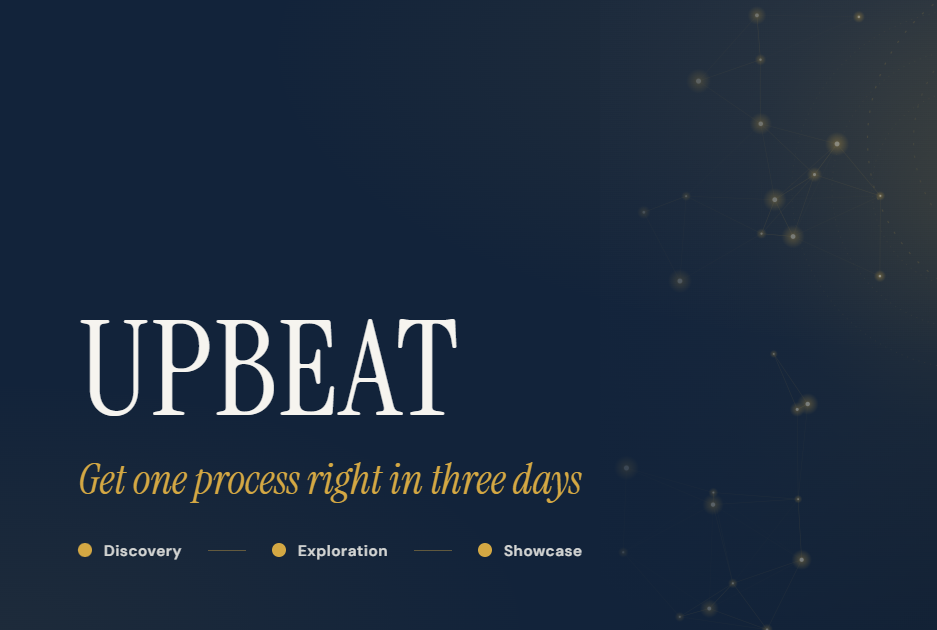
This is what UPBEAT is for.
It is three days spent on one process, done properly, before you spend anything on tools.
On the first day we help you choose the process worth starting with, sit with the people who actually run it, and document it to a standard the industry recognises, exceptions and judgment calls included. We agree with you up front what a good result looks like, so the three days are measured against something concrete.
On the second we look at where the process slows down or breaks, and set out the options for fixing it. Sometimes that is an off-the-shelf tool, sometimes one of our own accelerators, sometimes something built for you. The solution follows the problem, not the other way round.
On the third we put the solution in front of you working on real cases from your business, so you can see exactly what it does and where it helps. If it earns its place, you get a clear plan to roll it out. If it does not, we agree the next steps honestly.
If you are not happy at any point in the three days, we stop and refund the days you have not used. If you want to carry on, we plan the next steps together.
One fixed price, £3,000 plus VAT for the three days. No hidden costs.
If that sounds like the right place to start, the first step is a short call to agree the one process worth beginning with and to check it is a good fit.
https://consulting.veziroglu.co.uk/upbeat
Emrah
Veziroglu Consulting