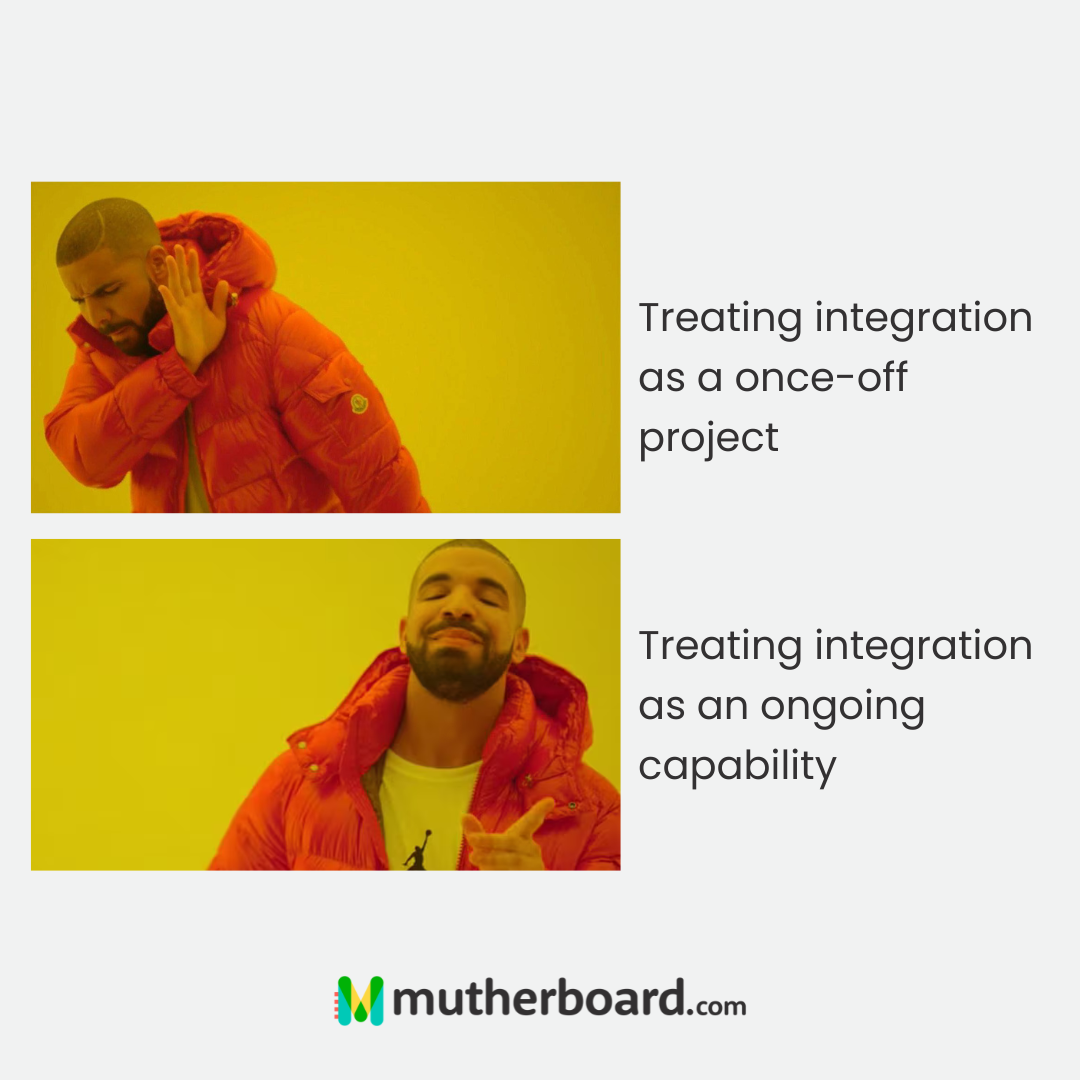
Many organisations approach integration with a project mindset.
A new CRM is implemented. An ERP system is upgraded. A marketing platform is introduced. The team builds the necessary connections between systems, celebrates the successful launch, and moves on to the next priority.
The problem is that integration is rarely ever finished.
Businesses are constantly evolving. New applications are adopted. Existing platforms receive updates. Processes change as teams grow and customer expectations shift. What worked perfectly six months ago may no longer support the way the business operates today.
Yet many companies continue to treat integration as a one-time initiative rather than an ongoing capability.
This creates a cycle that is both expensive and frustrating.
A system gets connected. Over time, new requirements emerge. Data starts becoming fragmented. Manual workarounds appear. Teams begin exporting spreadsheets to bridge gaps between platforms. Another integration project is launched to fix the growing problems. The cycle repeats itself.
The issue is not that the original integration was poorly designed.
The issue is that the organisation assumed integration had an end date.
Modern technology environments are living ecosystems. Every new tool, workflow, customer touchpoint, or business process affects how information moves through the organisation. Maintaining that flow requires continuous attention.
The most successful organisations recognise this reality. Instead of focusing solely on building integrations, they focus on building integration capability.
An integration capability includes the people, processes, governance, and technology needed to continuously manage how systems interact. It creates a framework for evaluating new tools, monitoring data quality, adapting workflows, and responding quickly when business requirements change.
This approach offers several advantages.
First, it improves agility. When integration is treated as an ongoing capability, organisations can adopt new technologies more quickly because there is already a structured approach for connecting them into the wider ecosystem.
Second, it reduces operational friction. Teams spend less time manually moving information between systems and more time focusing on meaningful work.
Third, it improves decision-making. Reliable integration creates consistent data across the organisation, giving leaders greater confidence in the information they use to guide strategy.
Most importantly, it allows technology investments to deliver value for longer. Systems become part of a connected environment rather than isolated tools that require constant intervention.
A useful analogy is to think about roads.
Building a road is a project. Maintaining a transportation network is a capability.
No city would build a road and assume the work is finished forever. Roads require maintenance, expansion, monitoring, and adaptation as traffic patterns change.
The same principle applies to business systems.
Integration is not about creating a few connections between applications and hoping they continue to work indefinitely. It is about creating the organisational capability to keep information flowing as the business evolves.
The companies that gain the greatest value from their technology are not necessarily the ones with the most tools. They are the ones that continuously ensure those tools work together.
The takeaway is simple: stop treating integration as something you complete. Start treating it as something you develop and improve over time.
Build integration capability, not just connections.